Case Study · Enterprise UX Leadership
Aligning UX across business, agency, and development in an enterprise rebuild
Translating a visually-driven agency design system into a coherent, implementable digital experience — across multiple teams, constraints, and design drops.
In addition to leading UX, I operated in an acting product owner capacity — helping drive prioritization, clarify requirements, and align decisions across business, agency, and development teams.
Context
01
The Bioscience website redesign was a large-scale enterprise project involving an external creative agency, multiple internal business units, and an external development team. Each brought a different lens: the agency brought brand vision, the business brought stakeholder priorities, and development brought technical constraints.
My role was to sit between them — translating agency creative direction into implementable interaction patterns, anchoring decisions in user need, and ensuring that what was designed in presentations would actually hold up through build.
Problem
02
"The design system provided strong visual direction, but was primarily structured around brand expression rather than digital interaction."
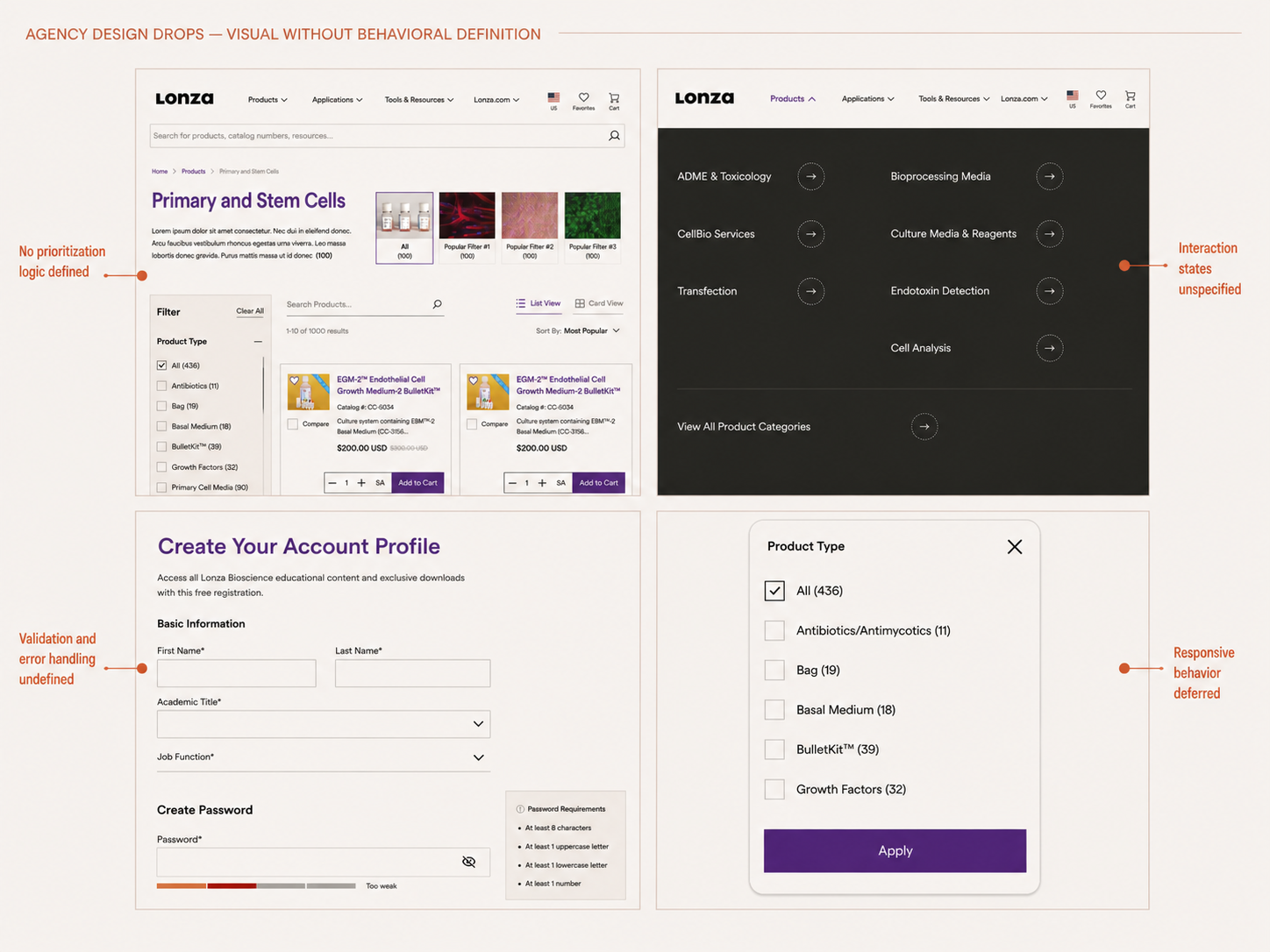
As a result, key interaction patterns, states, and behavioral guidelines were not fully defined, requiring additional UX interpretation during implementation. This made it difficult to rely solely on predefined components, requiring decisions to be grounded in established interaction patterns.
Agency design drops provided strong visual direction, but left interaction behavior, state management, and edge cases undefined.
My Role
03
This engagement was less about originating designs and more about ensuring design quality survived the distance between agency intent and development execution. The highest-value contribution was interpretation, specification, and alignment — not competing with the agency's creative direction, but completing it.
Approach
04
Translating System → Experience
The core challenge was that a beautifully crafted visual system doesn't automatically become a usable digital experience. The agency's work was strong — but it had been built to communicate brand, not to specify behavior. Translating it into something buildable required a structured interpretation layer across every major component and template.
Alignment Model — UX as Translation Layer
Input
Business
Goals, priorities, stakeholder constraints
Translation layer
UX
Interpretation, specification, alignment
Creative
Agency
Visual direction, brand system, layout
Build
Development
Technical execution, component build
Output
Experience
Coherent, usable digital product
Each arrow represents a translation step requiring explicit documentation and cross-team sign-off. UX sat at the center — not as a gatekeeper, but as the function responsible for coherence.
Clarifying Interaction Behavior
For each major component, I worked through the interaction states the agency comps left open. This wasn't a critique of the agency's work — it was a recognition that static visual design and interaction specification are different disciplines. The output was a layer of behavioral documentation that gave development the clarity they needed to build accurately.
Agency Direction
Visual system & static comps
UX Interpretation
Behavioral spec & annotation
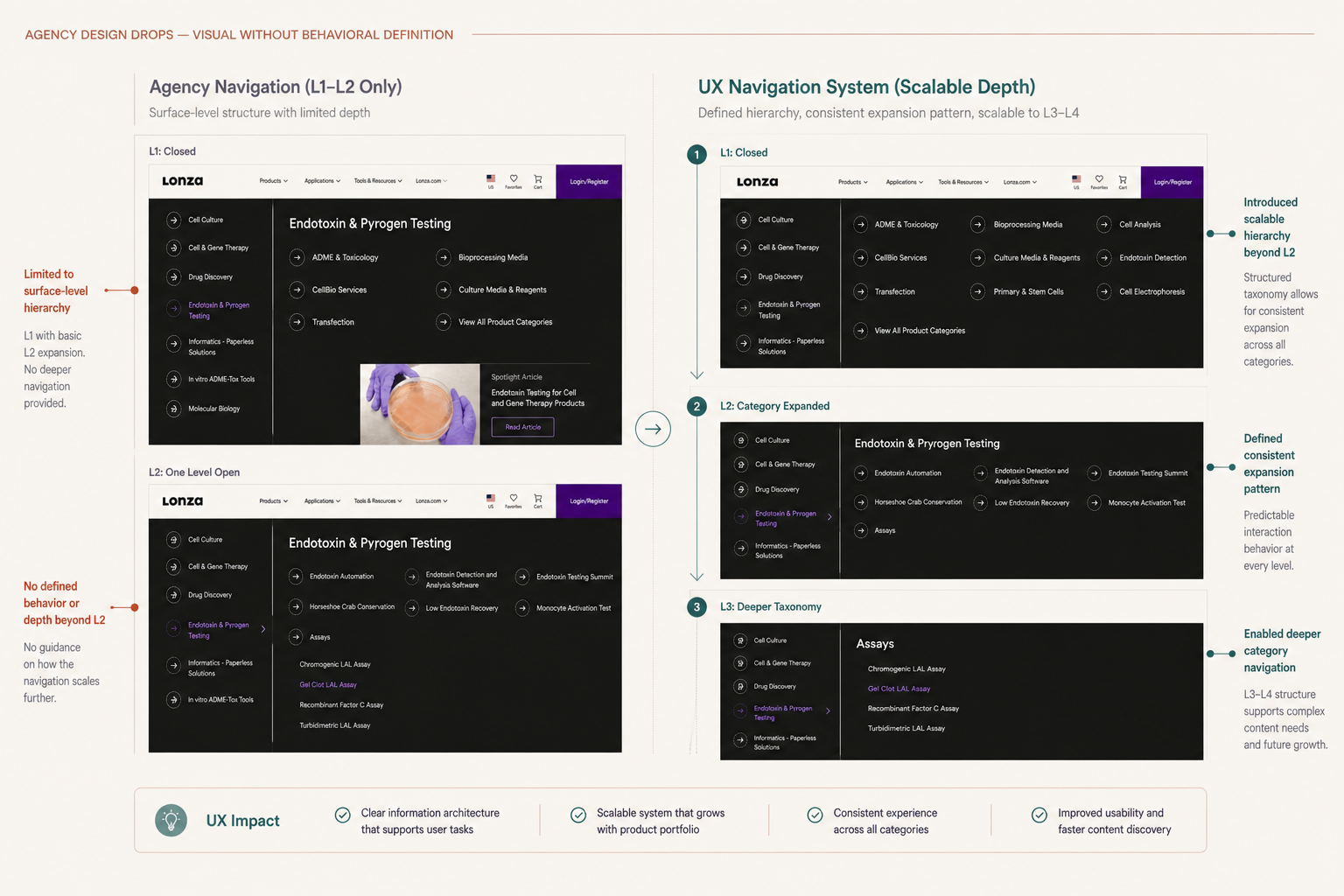
Agency direction (left) defined the visual system. UX interpretation (right) translated it into behavioral specifications development could build from.
Agency navigation defined surface-level structure (L1–L2), requiring UX to extend the system into a scalable, consistent hierarchy supporting deeper taxonomy and interaction patterns.
Where the visual system provided no guidance, decisions were anchored in established interaction patterns — familiar, tested, and defensible. This wasn't a compromise of the visual design; it was the work that made it buildable.
Aligning Across Teams
The highest-risk moment in an agency-led project is the handoff from design to development. Without explicit documentation, developers interpret intent — and those interpretations are expensive to reverse. I introduced structured practices to close this gap at every handoff point.
From Design Intent to Build Clarity
Each step reduced interpretation risk by turning visual intent into documented behavior, decisions, and acceptance criteria.
Interaction specifications and decision records created a shared interpretation layer between agency design and development execution.
Key Decisions
05
Prioritized usability over strict visual fidelity when needed
Where the visual system created interaction problems, those were surfaced and resolved before build — not silently implemented or quietly ignored.
Standardized interaction patterns across templates
Successive design drops had introduced inconsistencies. Rationalizing interaction behavior across templates — even where the visual treatment varied — created a more coherent user experience.
Clarified implementation behavior early to reduce rework
Introducing interaction specification upstream — before build, not during — meant development teams had what they needed at handoff, not after the first round of QA.
Anchored decisions in known UX patterns when system guidance was incomplete
Rather than inventing solutions where the design system was silent, I drew from established interaction patterns — keeping the experience predictable and defensible across stakeholder reviews.
What Changed
06
The clearest measure of success in an alignment-focused engagement isn't visual — it's operational. The outcomes reflected a project that moved from fragmented intent to coherent execution.
Design → Development
Reduced ambiguity at handoff. Developers had behavioral specifications before they started building, not after the first round of questions.
Interaction consistency
More consistent interaction patterns across the experience — despite variation in visual treatment across templates and design drops.
Stakeholder alignment
Business, agency, and development operating from a shared understanding of UX decisions — with documented rationale, not tribal knowledge.
Implementation readiness
UX direction that was implementation-ready at the point of handoff — reducing the gap between what was designed and what was built.
Prioritization clarity
Explicit, documented decisions about scope, sequencing, and trade-offs — reducing the ambiguity that typically accumulates in multi-stakeholder delivery environments.
Outcome
07
The redesign launched on schedule with significantly fewer late-stage design revisions than comparable enterprise projects. The structured interpretation layer reduced ambiguity at handoff, and the cross-team alignment practices kept all functions moving from the same understanding throughout build.
The most significant outcome was less visible than a launch metric: the gap between what was intended and what was built was smaller than it would otherwise have been. In enterprise projects with multiple competing voices, that gap is where experience quality is lost.
Reflection
08
"Enterprise UX is often less about designing new interfaces and more about ensuring that what is designed can actually be understood, implemented, and used effectively."
The Bioscience redesign reinforced a principle I rely on in complex enterprise environments: the most important UX work often happens before a single pixel is placed. Defining what's meant, documenting what's been decided, and ensuring everyone is working from the same understanding — these aren't administrative tasks. They are design work.
In agency-led projects, the internal UX lead's job is to protect the experience from the distance between intention and execution. That requires different skills than product UX — more translation, more facilitation, more documentation. But the outcome it protects is the same: an experience that works for the people using it.